OMG – I need to talk about Salt and Sodium!
Salt vs. Sodium: What’s the Difference?
I love salt—for the longest time, I thought sodium was salt and salt was sodium. I had no idea there was a massive difference between the two until not too long ago.
In my opinion, salt is probably the most deeply personal thing a person can deal with when it comes to cooking and eating. Think about it: our salt choices are entirely our own. Some people salt their food before they even taste it. Others taste it first. Sometimes it’s a tiny pinch, sometimes it’s a lot, and sometimes we are reaching for an entirely different kind of salt altogether. It’s a ritual, and it’s personal.
We all have grown up knowing what Salt & Pepper is – They’re the default seasoning on almost every table.
The very first thing I figured out was that I had to start checking the labels for sodium on processed foods—soups, beans, and honestly, just about anything in a can. Processed meats like sausages, and especially anything that is cooked or cured like pork, are packed with sodium to help give them flavor and preserve them. I used to be incredibly naive about it. I’d open a can of green beans, cook them up, and immediately think, “Well, I need to salt these.” Meanwhile, they were already heavily salted with sodium before they ever hit my kitchen counter!
Keep an eye on the label—that is the single biggest lesson right there.
If I am cooking at home and want to use salt, I know that for cardiac health, blood pressure, and other medical reasons, I have about 2/3 of a teaspoon of salt to work with every single day. That means literally a pinch of salt here, a pinch of salt there. If I make a completely salt-free dish, I can put an actual pinch right on top if I want to. Look, if I happen to go over my 1,500 mg target on a given day, that’s my choice. I’m not going to freak out or act like it’s the end of the world. But, I will be conscientious of my 1,500mg sodium limit from now on.
It all changed how I look at my food, and that’s why I wanted to offer this explanation of salt versus sodium. Doctors don’t actually care about salt. Nutritionists don’t care about salt. They care about sodium. That is the big takeaway.
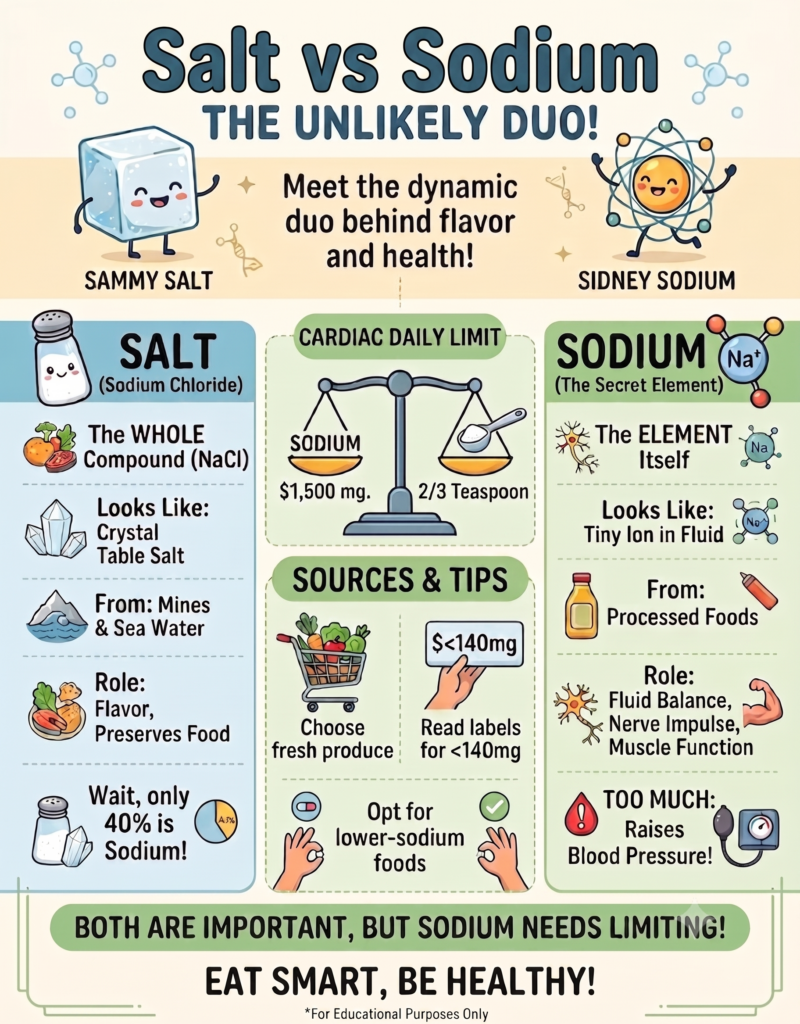
I hope you enjoy the post! To get us started, here is a wonderful little infographic I created with the help of my AI assistant to break it all down.
The Sodium-to-Salt Conversion Cheat Sheet
Most people confuse sodium weight (mg) with salt volume (teaspoons). Table salt is 40% sodium and 60% chloride. So, when you try to cut “sodium,” the volume of salt you actually need to reduce is different than you might think.
| If you aim for this much Sodium (mg)… | …it is equivalent to this much Table Salt (Teaspoons) |
|---|---|
| 575 mg (About 1/4 of the adult daily max) | 1/4 teaspoon |
| 1,150 mg | 1/2 teaspoon |
| 1,500 mg (Cardiac Daily Limit Target) | 2/3 to 3/4 of a teaspoon (A flat 2/3 tsp is about 1,530 mg) |
| 1,725 mg | 3/4 teaspoon |
| 2,300 mg (Standard Healthy Adult Limit) | 1 full teaspoon |
FAQ – So, I don’t have to cut out salt completely?
Exactly! You don’t have to banish your salt shaker from existence. It’s about being mindful of the quantity and where the true source of sodium is coming from.
Your body actually needs some sodium to function (as that “Fluid Balance” nerve impulse point on the visual shows). The trick is to stay within those limits, like the 1,500 mg daily limit shown on the scale above. It’s okay to add a little pinch of salt to home-cooked vegetables or a single recipe, provided you know how much other processed food is in your day!
Three Tips to Lower Sodium (Without losing flavor!)
If you are like me and trying to cut back on sodium, the salt shaker isn’t actually your biggest enemy.
-
Reduce Processed Foods: This is where 70%+ of American sodium comes from. If you reduce canned soups, deli meats, and frozen dinners, you will automatically slash your sodium intake.
-
Use Herbs and Spices: Lean into other flavors like garlic, lemon juice, black pepper, and onion powder instead of reaching for the salt. I personally love smoked paprika!
-
Read Labels: Don’t assume. Check the nutrition label. Even things that don’t taste super salty can have hidden sodium (like many bread brands, sauces, and cereals).
Data Sources & References
-
Salt-to-Sodium Conversion Math: The chemical composition breakdown (table salt being roughly 40% sodium and 60% chloride) and the corresponding volume-to-weight measurements (e.g., $1\text{ tsp of salt} \approx 2,300\text{ mg of sodium}$) are based on nutritional standards verified by the U.S. Department of Agriculture (USDA) and FDA Nutrition Labeling Standards.
-
Dietary Sodium Sources: Data indicating that more than 70% of average dietary sodium comes from packaged, processed, and restaurant foods—rather than the home salt shaker—is provided by the U.S. Food and Drug Administration (FDA) and the Centers for Disease Control and Prevention (CDC).
-
Low-Sodium Labeling Claims: The legal definition of “Low Sodium” on a food product package ($140\text{ mg}$ or less per serving) is strictly regulated by the U.S. Food and Drug Administration (FDA).